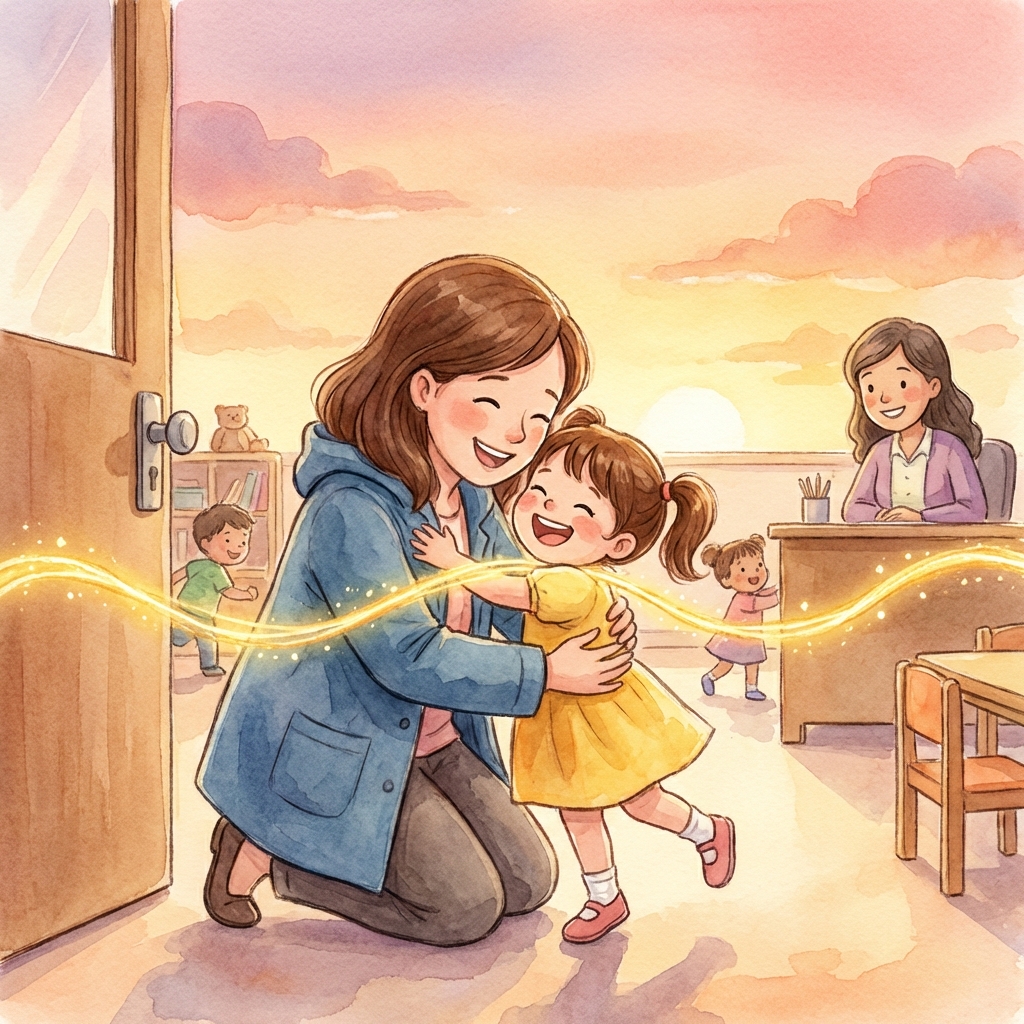
How to prepare a toddler for their first day of daycare: what the research supports
Starting daycare is one of the first big separations of a child's life. The good news: decades of attachment research point to a handful of specific, practical things parents can do in the week before that measurably ease the transition.
If your child's first day of daycare is circled on the calendar and your stomach tightens every time you look at it, you are in good company. The research is honest about this: starting child care is a real stressor for toddlers, not an imagined one. But the same research shows that preparation works — and that a few specific choices in the week before the first day make a measurable difference to how a child settles.
Why the first day is genuinely hard — and genuinely fine
The single most informative study on this transition followed seventy 15-month-olds through their first weeks of child care in Germany, measuring both behaviour and salivary cortisol — a stress hormone. In the first days without their mothers, the toddlers' cortisol rose to levels 75–100% higher than at home.1 That is a real, physiological stress response, and it is completely normal.
The same study found two things every parent should know. First, children whose parents spent more days easing them in — staying at the service during an adaptation phase before the first full separation — were more likely to remain securely attached through the transition. Second, the stress response faded over weeks, not days.1 Preparation and patience are not just nice-to-haves; they are the two variables the evidence says matter most.
In other words: distress at the start is expected, and it does not mean daycare is harming your child or that you have chosen the wrong service. What you do around the transition is what shapes how it goes.
Step 1: Visit together before the first day
Both ACECQA's Starting Blocks guidance and the Raising Children Network — the Australian Government-funded parenting resource — recommend orientation visits as the first practical step: attend the service together, ideally more than once, before your child's first real day.64
A good visit is not a tour for you — it is an experience for them:
- Let your child explore the room while you stay visibly nearby.
- Introduce them to the educator who will greet them on day one, and let the educator lead a short interaction — a puzzle, a book — while you watch.
- Point out concrete landmarks they will meet again: the fish tank, the bag hooks, the outdoor sandpit. Toddlers anchor to specifics, not concepts.
- If the service offers staggered starts — short days building to full days — take them. The Ahnert study suggests a gradual adaptation phase is one of the strongest protective factors we know of.1
Step 2: Talk about it — concretely, not constantly
Toddlers cope better with what they can predict. In the days before the start, talk about daycare in short, concrete, positive terms: who will be there, what they will do, and — crucially — that you will come back. Raising Children Network suggests framing the reunion in toddler time, not clock time: "after afternoon tea" means something; "at 5 pm" does not.4
The balance matters. One or two brief, warm conversations a day beats a running commentary. Over-talking a future event can signal to a small child that it is something to worry about — a dynamic that shows up repeatedly in the child-anxiety literature (we cover the related evidence in our piece on separation anxiety at drop-off).
Step 3: Rehearse it through stories
Story-based rehearsal — walking a child through an upcoming situation in narrative form, ideally with themselves as the main character — has one of the more interesting evidence bases in early childhood. The best-studied format is the Social Story framework, originally developed for autistic children: a systematic review of controlled trials concluded such stories can help modify behaviour and ease unfamiliar social situations, with personalisation to the specific child being a key ingredient.7 The underlying mechanism — making an unpredictable situation predictable, step by step, before it happens — is exactly what a toddler starting daycare needs.
In practice: in the week before the start, read a story about starting daycare every day or two, at a calm moment (not at bedtime on the last night). The closer the story matches your child's actual experience — their name, their room, their educator, their goodbye ritual — the more it functions as rehearsal rather than just entertainment. This is the research basis for how Little Narratives builds its 5-day daycare preparation plans: a personalised story and song a day, starring your child, in the lead-up to their first day. You can read more about the framework on our Social Stories explained page, or see how the 5-day plan works.
Step 4: Design your goodbye ritual in advance
The classic observational study here was run by Tiffany Field and colleagues, who watched real drop-offs at a nursery school and coded what parents did and how children responded. The findings have aged remarkably well: hovering, long-drawn-out departures, and — worst of all — sneaking out of the room were the parent behaviours most associated with child distress at leave-taking and with clingy, ambivalent behaviour at reunion.2
Step 5: Pack a piece of home
The teddy, the muslin, the impossibly grubby blanket — paediatric psychology has taken these seriously since Donald Winnicott described "transitional objects" in 1953: possessions that carry the felt security of the caregiver into places the caregiver is not.3 Australian guidance agrees on the practical point: let your child take a comfort object from home, tell the educators what it is and when it helps, and let it be phased out naturally as your child settles.6
Some services limit toys from home, so check first — most will happily make an exception for a genuine comfort object during settling-in, and family photos in the child's locker or room are a common alternative.
The week-before plan, day by day
Pulling the evidence together into one practical sequence:
- 7–5 days out: orientation visit together. Meet the educator. Name the landmarks. Start reading a daycare story every day or two.
- 4–3 days out: short, concrete chats about what will happen. Practise brief separations if they are not already routine — an hour with grandparents or a trusted friend.4
- 2 days out: agree on the goodbye ritual and rehearse it as a game. Choose the comfort object together and pack the bag with your child helping.
- 1 day out: a calm, ordinary day. Early night. Keep the story reading light and confident — your child reads your tone more than your words.
- Day one: unhurried morning, the ritual exactly as rehearsed, a warm short goodbye, and — if it helps you — a phone call to the service mid-morning. Children who cry at drop-off very often settle within minutes.5
- The first weeks: expect tiredness and bigger feelings at home; daycare is stimulating. Earlier bedtimes, quiet play, and extra one-on-one time help — and remember the cortisol data: the stress response fades over weeks.15 Why transitions in general are hard work for toddler brains is a story of its own — see our explainer on why transitions are so hard for toddlers.
When to talk to a professional
None of this needs to be perfect. The evidence does not ask parents to be flawless — it asks for a bit of familiarity before day one, honest predictable goodbyes, and steady warmth while a small person does one of the bravest things they have done yet. That, the research supports entirely.
References & further reading
- Ahnert, L., Gunnar, M. R., Lamb, M. E., & Barthel, M. (2004). Transition to child care: Associations with infant–mother attachment, infant negative emotion, and cortisol elevations. Child Development, 75(3), 639–650.
- Field, T., Gewirtz, J. L., Cohen, D., Garcia, R., Greenberg, R., & Collins, K. (1984). Leave-takings and reunions of infants, toddlers, preschoolers, and their parents. Child Development, 55(2), 628–635.
- Winnicott, D. W. (1953). Transitional objects and transitional phenomena — a study of the first not-me possession. International Journal of Psycho-Analysis, 34, 89–97.
- Raising Children Network (Australia). Starting child care: how to handle separation anxiety and fear of strangers.
- Raising Children Network (Australia). Settling in at child care: the early weeks.
- StartingBlocks.gov.au (ACECQA). Preparing to start at a children's education and care service.
- Karkhaneh, M., Clark, B., Ospina, M. B., Seida, J. C., Smith, V., & Hartling, L. (2010). Social Stories™ to improve social skills in children with autism spectrum disorder: A systematic review. Autism, 14(6), 641–662.