Why transitions are so hard for toddlers — and what predictability does to a developing brain
The meltdown at the park gate and the tears on the first day of daycare look different, but they share a root cause: a brain that is still building the machinery for switching gears — and that depends on predictability adults barely notice.
Every parent of a toddler knows the scene: the afternoon is going beautifully until it is time to leave the park, and a small, previously delightful person dissolves. Toddlers do not struggle with transitions because they are stubborn or spoiled. They struggle because transitions make demands on exactly the brain systems that are least developed at age two — and understanding that changes both what we expect and what we do.
Two kinds of transitions, one underlying problem
It helps to see the small and large transitions as one family. The micro-transitions — leaving the park, ending bath time, turning off the TV — demand that a child stop one engaging thing and start another, on someone else's schedule. The macro-transitions — the first day of daycare, a new sibling, the first dentist visit, a needle at the doctor's — demand that a child walk into a situation their mind cannot yet picture. Both are, at bottom, the same problem: the future is being asked of a brain that runs almost entirely on the present.
The executive function gap
The mental machinery for handling transitions has a name: executive function. In Adele Diamond's authoritative review, its three core components are inhibitory control (stopping an ongoing impulse or activity), working memory (holding a plan in mind — "we're leaving so we can have lunch"), and cognitive flexibility (shifting smoothly from one mental set to another).1 A transition uses all three at once: stop what you are doing, remember what comes next, and reorient to it.
Here is the developmental catch: these capacities depend on the prefrontal cortex, which is among the last brain regions to mature — continuing to develop into a person's twenties. Harvard's Center on the Developing Child describes executive function as the brain's "air traffic control system", and makes the crucial point that children are not born with these skills, only with the potential to build them, slowly, through experience with supportive adults.2 A two-year-old asked to leave the sandpit is being asked to run air traffic control with a tower that is still under construction.
Diamond's review adds a finding every parent should have framed on the wall: executive functions are the first thing to suffer under stress, sleep deprivation, or big emotion — at any age.1 A tired, hungry, overstimulated toddler does not have less character; they temporarily have even less prefrontal capacity than usual. The 5 pm meltdown is neurology, not defiance. (For the related question of how children gradually learn to manage big feelings at all, see our piece on behaviour management versus emotional regulation.)
What predictability does to a developing stress system
If executive function is the machinery, predictability is the load-reducer. The developmental neuroscience of stress, reviewed by Gunnar and Quevedo, shows that young children's stress systems are powerfully regulated by two things: the predictability of what happens to them, and the presence of responsive caregivers who act as an external buffer while internal regulation is still being built.3 Novel, uncontrollable, unpredictable situations are exactly the conditions that activate the stress response — which is a fair description of most toddler transitions, from the toddler's side.
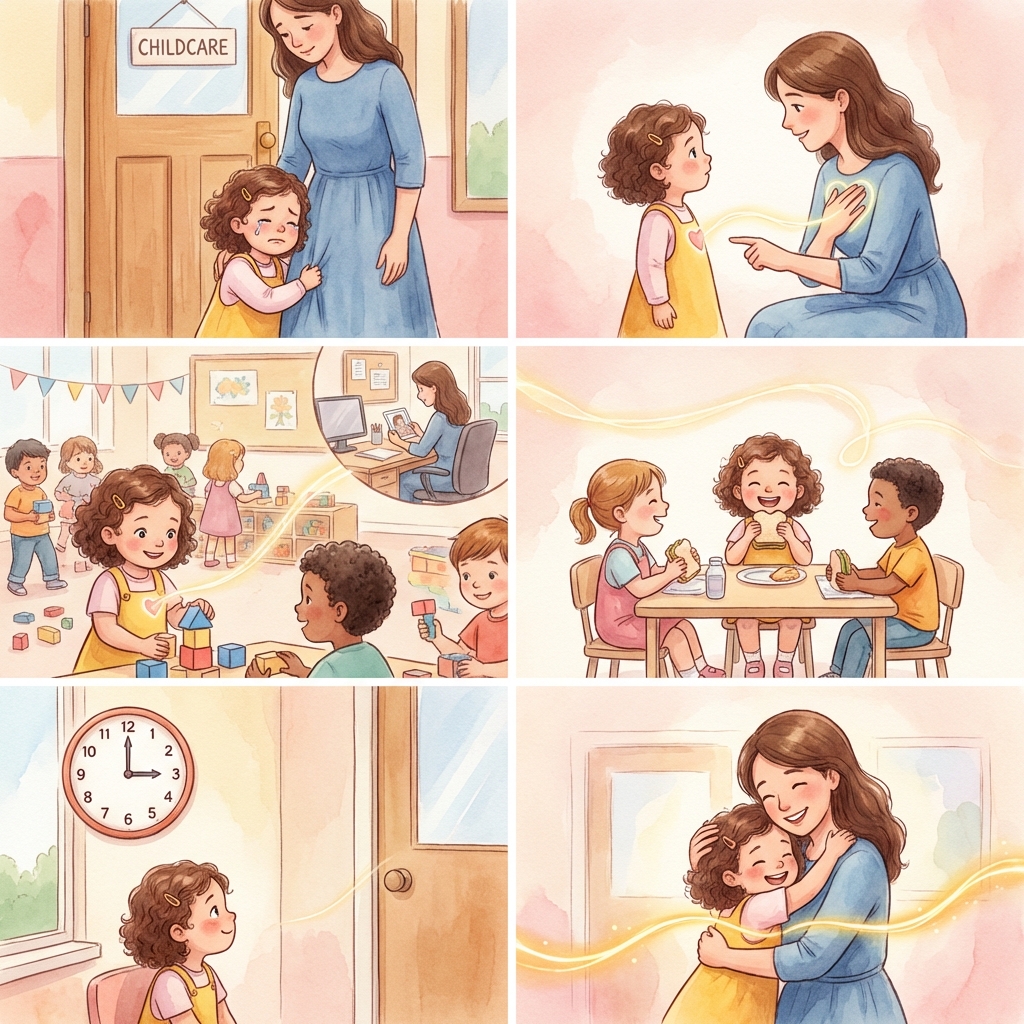
You can watch this play out in the child care transition literature: toddlers starting daycare showed cortisol elevations of 75–100% above home baseline in the first days of separation, which eased over weeks as the setting became familiar — and eased fastest with a gradual, parent-supported adaptation.5 Familiarity is not a nicety; it is measurable stress chemistry. We unpack that study — and what it means for drop-offs — in separation anxiety at daycare drop-off.
Transition warnings: small predictability, big effect
The humble transition warning — "two more slides, then we go" — is predictability at the smallest scale. It works with the grain of an immature brain rather than against it: the warning loads the plan into working memory in advance, so the stop, when it comes, is a known event rather than an ambush to be inhibited in real time.1
- Make warnings concrete. "Five minutes" means little to a toddler; "two more slides" or "when this song finishes" is countable.
- Keep the sequence visible. "First shoes, then car, then lunch" — the classic first–then framing — narrates the plan their brain cannot yet hold alone.6
- Same order, every time. A leaving-the-park ritual done identically each visit becomes self-predicting: the ritual itself is the warning.
- Expect protest anyway, sometimes. Warnings reduce the load; they do not install a finished prefrontal cortex.
Routines: predictability at the scale of a day
Zoom out from a single moment to a whole day and you get routines — and here the developmental evidence is broad. Spagnola and Fiese's review in Infants & Young Children found that regular family routines provide "a predictable structure that guides behaviour and an emotional climate that supports early development", with variations in routines associated with differences in language, social-emotional and academic development.4 Australian guidance says the same in plainer words: an organised, predictable home environment helps children feel safe and secure — and predictable family life particularly helps children cope during life events like the birth of a sibling, illness, or a house move.6
The mechanism loops back to executive function. Every step of the day a routine makes automatic — bath, book, bed, in that order, every night — is a step that no longer needs scarce prefrontal effort from the child (or negotiation from the parent). Routines are not rigidity; they are scaffolding that frees a toddler's limited cognitive budget for the genuinely new.2
Rehearsal: predictability for the big transitions
Warnings handle the next five minutes and routines handle the ordinary day — but the big transitions are hard precisely because they cannot be made familiar in advance. You cannot do a practice run of a sibling being born. What you can do is rehearse it narratively: stories, role-play and walk-throughs that give a child an accurate mental script of what is coming, so the real event lands as recognition rather than ambush. That principle shows up independently across the preparation literature — story-based rehearsal for social situations, pre-visit imagery and tell-show-do in paediatric dentistry, honest preparatory information before medical procedures — each covered in the posts linked above, and each a member of the same family: predictability, delivered in advance, in a form a small child can hold.
When to talk to a professional
The next time the park-gate meltdown arrives, it may help to translate it: this is not a child refusing to cooperate, it is a brain being asked to do its hardest thing with its newest machinery. Warnings, routines and rehearsal will not eliminate the protest — but the research says they shrink it, and that every predictable transition is also practice, laying down the circuitry that will one day make change easy.
References & further reading
- Diamond, A. (2013). Executive Functions. Annual Review of Psychology, 64, 135–168.
- Center on the Developing Child, Harvard University. Executive Function & Self-Regulation (key concepts).
- Gunnar, M. R., & Quevedo, K. (2007). The neurobiology of stress and development. Annual Review of Psychology, 58, 145–173.
- Spagnola, M., & Fiese, B. H. (2007). Family routines and rituals: A context for development in the lives of young children. Infants & Young Children, 20(4), 284–299.
- Ahnert, L., Gunnar, M. R., Lamb, M. E., & Barthel, M. (2004). Transition to child care: Associations with infant–mother attachment, infant negative emotion, and cortisol elevations. Child Development, 75(3), 639–650.
- Raising Children Network (Australia). Routines for families: how and why they work.