Needles, check-ups and hospital visits: the paediatric research on preparing young children
Needle fear that starts in early childhood can follow a person for decades — into vaccine hesitancy and avoided health care. The paediatric procedural-pain literature is refreshingly specific about what prevents it, and some of the answers are not what parents expect.
Immunisations, blood tests, check-ups, the occasional emergency department visit: needles and doctors are a non-negotiable part of early childhood. What is negotiable is how they feel. Procedural pain and fear in children is one of the best-researched corners of paediatric psychology, complete with clinical practice guidelines and Cochrane reviews — and its central message is that the experience is highly modifiable by what adults do before and during the appointment.
Why preparation matters more than bravery
The Canadian clinical practice guideline on vaccine injection pain — the most comprehensive in the world, developed by the HELPinKids&Adults team and published in the CMAJ — starts from a blunt observation: negative needle experiences in childhood can seed a lasting fear of needles, which in turn contributes to vaccine hesitancy and avoidance of health care across the lifespan.1 Preventing that fear is not about raising stoic children; it is about managing pain and fear properly in the first place, using procedural, physical, psychological and process interventions the guideline organises into a "5P" framework.1
Honest, age-appropriate information — the evidence
The research on preparatory information, synthesised in a widely cited review by Jaaniste, Hayes and von Baeyer, converges on a principle that sounds simple and gets violated constantly: children cope better when they are given accurate, age-appropriate information about what will happen and what it will feel like — in advance, at a calm moment, not in the car park.4
- What happens: "The nurse will clean your arm with a cold wipe, then you'll feel a quick pinch, then we put on the sticker." Procedural steps in child-sized language.
- What it feels like: sensory information — cold, quick, a pinch — is consistently more helpful than emotional forecasts.4
- When to tell them: for toddlers and preschoolers, a day or so of notice is generally plenty; for older children, more lead time lets them rehearse coping. Springing it at the last second erodes trust; weeks of anticipation feed worry.4
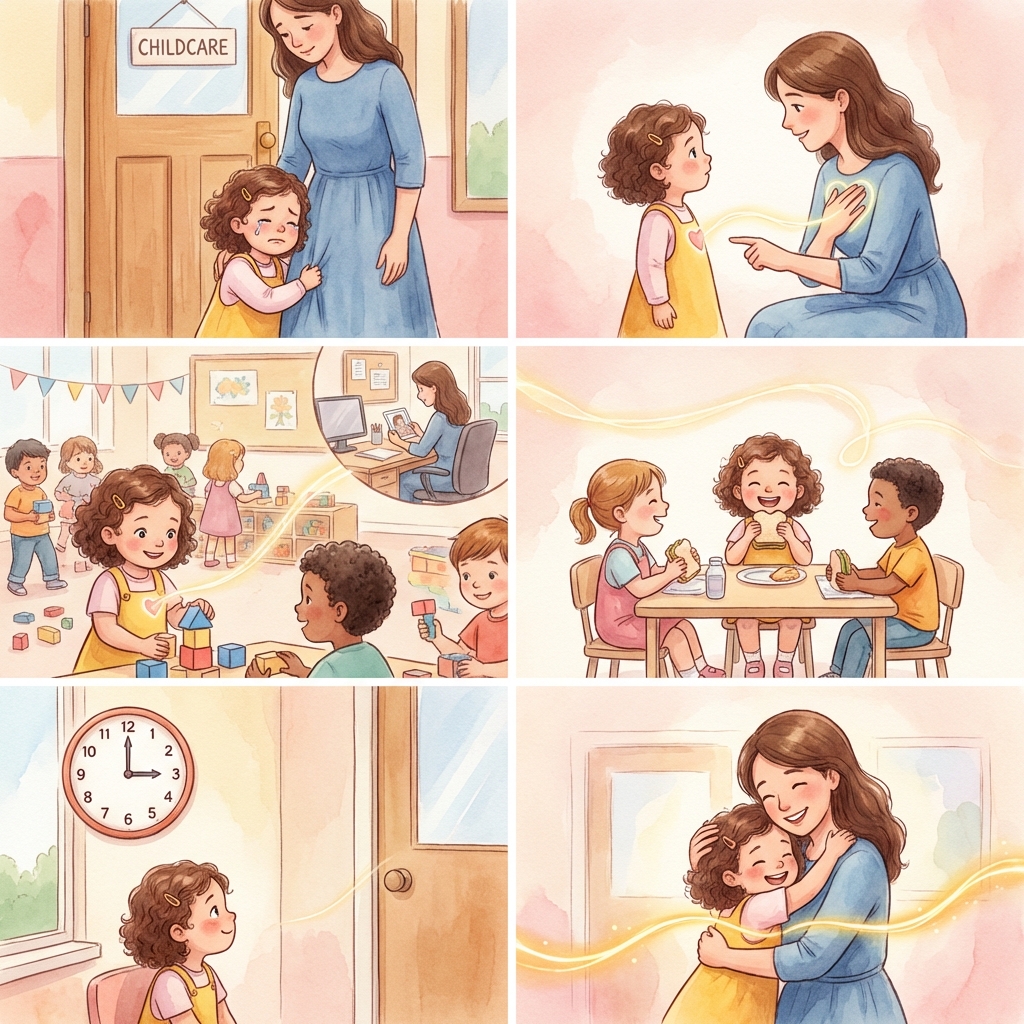
Rehearsal amplifies honest information. The classic Melamed experiments showed children who watched a filmed peer calmly cope with treatment were measurably less fearful and disruptive in their own appointments6 — the same modelling-and-rehearsal principle that underpins story-based preparation. Walking a child through the appointment in a story where they are the main character — the waiting room, the pinch, the sticker, the milkshake after — lets them run the event safely in advance. That mechanism is the foundation of the Social Story framework, and it is how the Little Narratives 5-day plan approaches doctor and needle preparation: an honest, gentle, personalised rehearsal a day in the lead-up.
Why "it won't hurt" and "don't worry" backfire
The most counterintuitive finding in this literature: parental reassurance — "it's okay, don't worry, it won't hurt" — is consistently associated with more child distress during procedures, not less. A landmark study in Pain by McMurtry and colleagues worked out why. When children watched clips of their parents reassuring versus distracting them, they rated their parents as more fearful during reassurance. To a child, a stream of "don't worry" reads as evidence that there is something to worry about.2
Distraction: the Cochrane-level evidence
If reassurance is the trap, distraction is the tool. The Cochrane systematic review of psychological interventions for needle-related pain and distress — 39 trials, several thousand children — found strong evidence for distraction (and hypnosis, in older children) in reducing self-reported pain and distress.3 The vaccination guideline turns that into concrete clinical recommendations: distraction with toys, videos, music or conversation, breathing strategies ("blow out the birthday candles"), and for infants, breastfeeding or sweet solutions during the injection.1
Distraction works best when it is engaging and started before the needle, not scrambled together mid-cry. Bring the specific book, bubble wand, or video your child cannot ignore, and get it running in the waiting room.
Comfort positioning: upright, held, and calm
Position matters more than most parents realise. The CMAJ guideline recommends against laying children flat and in favour of upright positions — for young children, that usually means sitting on a parent's lap, held in a secure cuddle, sometimes chest-to-chest.1 Being pinned supine is frightening in a way sitting upright in a parent's arms is not, and the guideline treats parental presence for young children as part of good procedure care.1 Ask your GP or immunisation nurse about a "comfort hold" — Australian immunisation providers know these well.
The CARD system: a framework worth knowing
If you want the evidence packaged into something memorable, the same research group behind the CMAJ guideline developed the CARD system — Comfort, Ask, Relax, Distract — a framework for planning vaccinations that bundles the evidence-based strategies into four child-centred categories.5 Originally built for school immunisation programs, its logic scales down neatly to a toddler's appointment:
- Comfort: upright positioning, a parent's lap, the comfort object from home.
- Ask: let the child ask questions and make real choices — which arm, which sticker, watch or look away.
- Relax: slow breathing, calm adult voices, no hovering panic.
- Distract: the video, the bubbles, the count-the-spots game — running before the needle appears.
Putting it together: before, during, after
Two related reads: the same preparation principles applied to the dental chair in preparing a toddler for the dentist, and the bigger developmental picture of why unfamiliar situations are so hard for small children in why transitions are so hard for toddlers.
When to talk to a professional
No parent can make a needle painless. What the research says you can do is make it predictable, brief, and safely accompanied — honest words the day before, a lap and a distraction during, and a story afterwards that ends with a sticker instead of a betrayal. Done consistently, that is how children learn that hard moments are survivable — which is the real inoculation.
References & further reading
- Taddio, A., McMurtry, C. M., Shah, V., et al. (2015). Reducing pain during vaccine injections: clinical practice guideline. CMAJ, 187(13), 975–982.
- McMurtry, C. M., Chambers, C. T., McGrath, P. J., & Asp, E. (2010). When "don't worry" communicates fear: Children's perceptions of parental reassurance and distraction during a painful medical procedure. Pain, 150(1), 52–58.
- Uman, L. S., Birnie, K. A., Noel, M., Parker, J. A., Chambers, C. T., McGrath, P. J., & Kisely, S. R. (2013). Psychological interventions for needle-related procedural pain and distress in children and adolescents. Cochrane Database of Systematic Reviews, Issue 10, CD005179.
- Jaaniste, T., Hayes, B., & von Baeyer, C. L. (2007). Providing children with information about forthcoming medical procedures: A review and synthesis. Clinical Psychology: Science and Practice, 14(2), 124–143.
- Taddio, A., McMurtry, C. M., Bucci, L. M., et al. (2019). Overview of a Knowledge Translation (KT) project to improve the vaccination experience at school: The CARD™ System. Paediatrics & Child Health, 24(Suppl 1), S3–S18.
- Melamed, B. G., Hawes, R. R., Heiby, E., & Glick, J. (1975). Use of filmed modeling to reduce uncooperative behavior of children during dental treatment. Journal of Dental Research, 54(4), 797–801.