Separation anxiety at daycare drop-off: what attachment research actually tells us
A toddler wailing at drop-off is one of parenting's most guilt-inducing moments. Seventy years of attachment research offers an unexpected reframe: the protest is usually evidence the system is working.
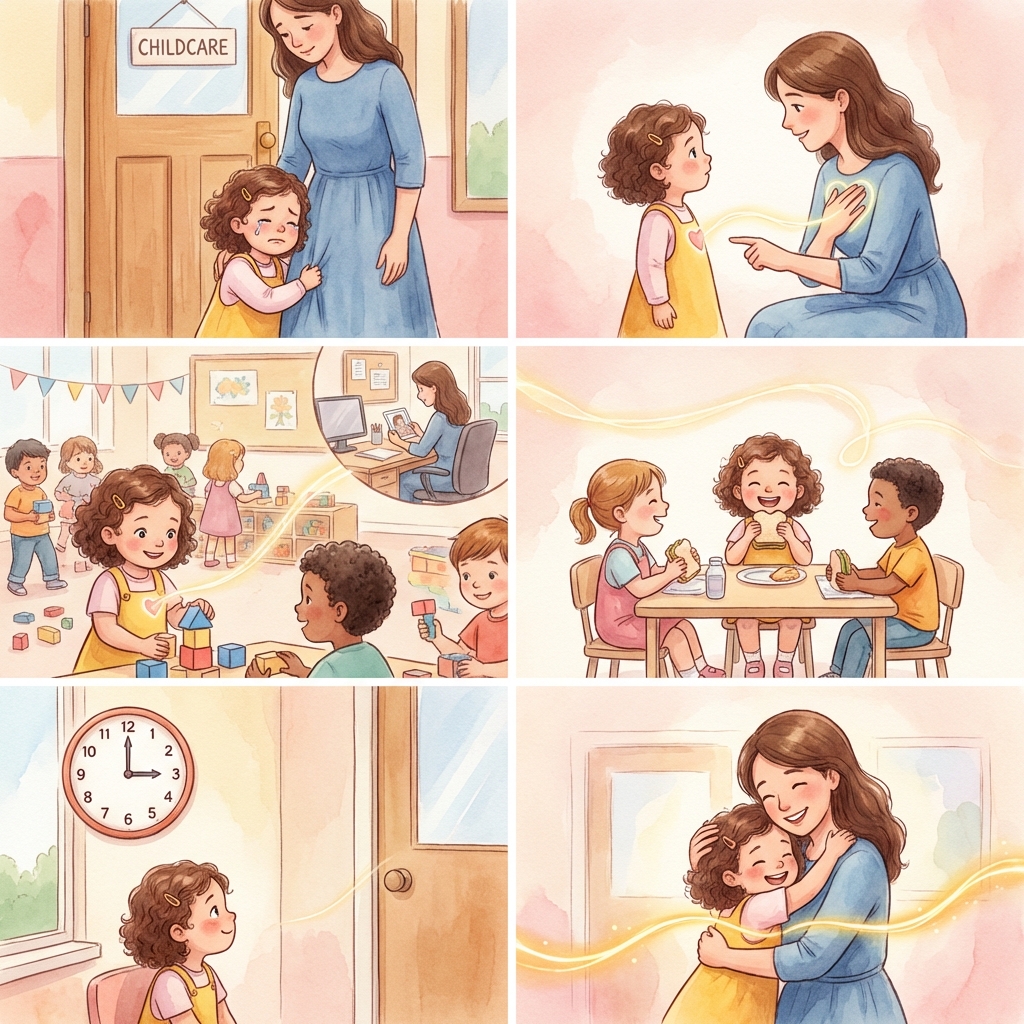
Few moments in early parenting feel worse than walking away from a crying child at daycare. It is worth saying clearly, before any theory: the research does not treat that crying as damage. It treats it as communication — and, in most cases, as a sign of a healthy attachment doing exactly what it evolved to do.
Separation anxiety is a developmental milestone, not a malfunction
Separation anxiety typically emerges around 6–7 months, peaks somewhere around 14–18 months, and fades gradually across early childhood.6 The timing is not random. It tracks the emergence of two cognitive abilities: the child now knows you exist when out of sight, but cannot yet reliably predict that you will come back. That gap — vivid memory of you, weak model of your return — is the engine of drop-off distress.
Notably, babies under about six months often separate easily, and the clinginess that appears later can look like a regression. It is the opposite: it means your child has developed a specific, preferred attachment to you. The protest is the price of the bond.
What Bowlby actually argued
John Bowlby, the British psychiatrist who founded attachment theory, made a claim that was radical in 1958: an infant's tie to their caregiver is not a by-product of feeding, but a biological system in its own right — built from instinctive behaviours like crying, clinging, and following, whose evolutionary job is to keep a small, vulnerable human close to a protective adult.1
Through that lens, drop-off protest is not manipulation and not weakness. A toddler who cries when you leave is running an ancient proximity-maintenance program: my safe person is leaving; sound the alarm. The program cannot yet be reasoned with — but it can be gradually updated with evidence, which is what every calm goodbye and reliable reunion provides.
Ainsworth's Strange Situation — what it showed
Mary Ainsworth turned Bowlby's theory into observable science. Her Strange Situation procedure, described in a landmark 1970 paper, put one-year-olds through a structured sequence of separations and reunions with their mother in an unfamiliar room, and coded the behaviour.2
Two findings matter enormously for how we read drop-offs:
- Distress at separation was the norm, not the exception. Securely attached children protested separation too. Security was never defined by not crying.
- The reunion is the telling moment. What distinguished securely attached children was that they sought comfort at reunion, were soothed by it, and returned to play. How your child greets you at pick-up says more than how they farewelled you at drop-off.
What normal protest looks like at drop-off
The modern study that best captures the physiology is Ahnert and colleagues' 2004 work following 15-month-olds starting child care: in the first days of real separation, toddlers' cortisol rose 75–100% above home levels, and fussing and crying peaked — then both declined over the following weeks and months.3 Interestingly, the securely attached toddlers in that study cried more during the separation phase, not less — using the signalling system they trusted — while their stress hormones told a calmer story over time.
Developmental stress research adds an important nuance: what buffers a young child's stress system is not the absence of challenge but the presence of reliable, responsive adults — at home and at the service.5 A child crying with a warm educator's arms around them is not an unbuffered child.
Normal protest, in practice:
- Crying, clinging, or protesting for minutes — not hours — after you leave.
- Settling into play once an educator engages them, often within 5–10 minutes.
- Big feelings at pick-up or at home — the day's held-together emotion releasing where it is safest.
- Gradual easing over the first several weeks, even if not in a straight line.
Two patterns often worry parents unnecessarily. The first is the out-of-nowhere relapse: a child who settled beautifully in week two starts protesting again in week six, often after a sick day, a holiday, or a change of educator. Regressions after breaks in routine are common and usually brief. The second is the child who separates cheerfully from one parent and dramatically from the other. That is not a verdict on either parent — children often save their loudest signalling for the person they feel safest protesting with. In both cases, the response is the same: keep the ritual steady, keep the goodbyes warm and brief, and let the pattern fade.
Why quick, warm goodbyes beat sneaking out
Tiffany Field's observational research on real nursery-school drop-offs coded exactly what parents did at the door. The behaviours associated with more child distress: hovering, prolonged departures, elaborate verbal explanations in the moment, and sneaking out of the room. Leave-taking distress was also correlated with ambivalent behaviour at reunion.4
Sneaking out deserves its own sentence, because it is so tempting. It works once — and then it teaches your child that you can vanish at any moment without warning, which is precisely the belief that fuels separation anxiety. Australian guidance is unambiguous: tell your child you are going, tell them when you will be back in terms they understand, do your goodbye ritual, and leave promptly.7
What the settling-in evidence says
The strongest protective factor in the Ahnert study was a genuine adaptation phase: mothers who spent more days easing their child into care — present at the service before the first full separation — had children whose attachment security was preserved through the transition.3 That converges with standard Australian settling-in practice: orientation visits, short days building to full days, a consistent educator, and comfort objects from home.7
Preparation before day one matters too — familiarity is the antidote to the unpredictability driving the anxiety. We have written a practical, week-before plan in how to prepare a toddler for their first day of daycare, and the broader science of why predictability calms small children in why transitions are so hard for toddlers. One evidence-aligned tool is story rehearsal: walking your child through the drop-off, the day, and — critically — the reunion, in narrative form before it happens. That is the approach behind the Little Narratives 5-day preparation plan, which turns the settling-in research into a personalised story and song a day starring your child.
When to talk to a professional
The tears at the gate are real, and so is the ache of walking away. But the attachment research offers a steadier way to read the moment: your child protests because you matter, settles because their educators are trustworthy, and lights up at pick-up because the system — theirs and yours — is working.
References & further reading
- Bowlby, J. (1958). The nature of the child's tie to his mother. International Journal of Psycho-Analysis, 39, 350–373.
- Ainsworth, M. D. S., & Bell, S. M. (1970). Attachment, exploration, and separation: Illustrated by the behavior of one-year-olds in a strange situation. Child Development, 41(1), 49–67.
- Ahnert, L., Gunnar, M. R., Lamb, M. E., & Barthel, M. (2004). Transition to child care: Associations with infant–mother attachment, infant negative emotion, and cortisol elevations. Child Development, 75(3), 639–650.
- Field, T., Gewirtz, J. L., Cohen, D., Garcia, R., Greenberg, R., & Collins, K. (1984). Leave-takings and reunions of infants, toddlers, preschoolers, and their parents. Child Development, 55(2), 628–635.
- Gunnar, M. R., & Quevedo, K. (2007). The neurobiology of stress and development. Annual Review of Psychology, 58, 145–173.
- Raising Children Network (Australia). What is separation anxiety in babies & children?
- Raising Children Network (Australia). Starting child care: how to handle separation anxiety and fear of strangers.