Rehearsing the big day in a story: the science of narrative preparation for young children
A three-year-old facing their first day of daycare can't reason their way through it, and a pep talk in the car park arrives far too late. What they can do — remarkably well — is rehearse. Four separate research literatures converge on the same conclusion: walking a child through the big day in narrative form, before it happens, changes how the day goes.
Much of early-childhood anxiety is not fear of a thing — it is fear of a blank. The first day of daycare, the dentist's chair, the arrival of a sibling: what unsettles a young child most is having no mental picture of what will happen, in what order, and where the safe adults will be. Narrative preparation fills in the blank ahead of time. It is the single mechanism underneath most of what works in preparing young children — and it has evidence behind it from at least four different research traditions that rarely get read together.
The mechanism: why rehearsal works
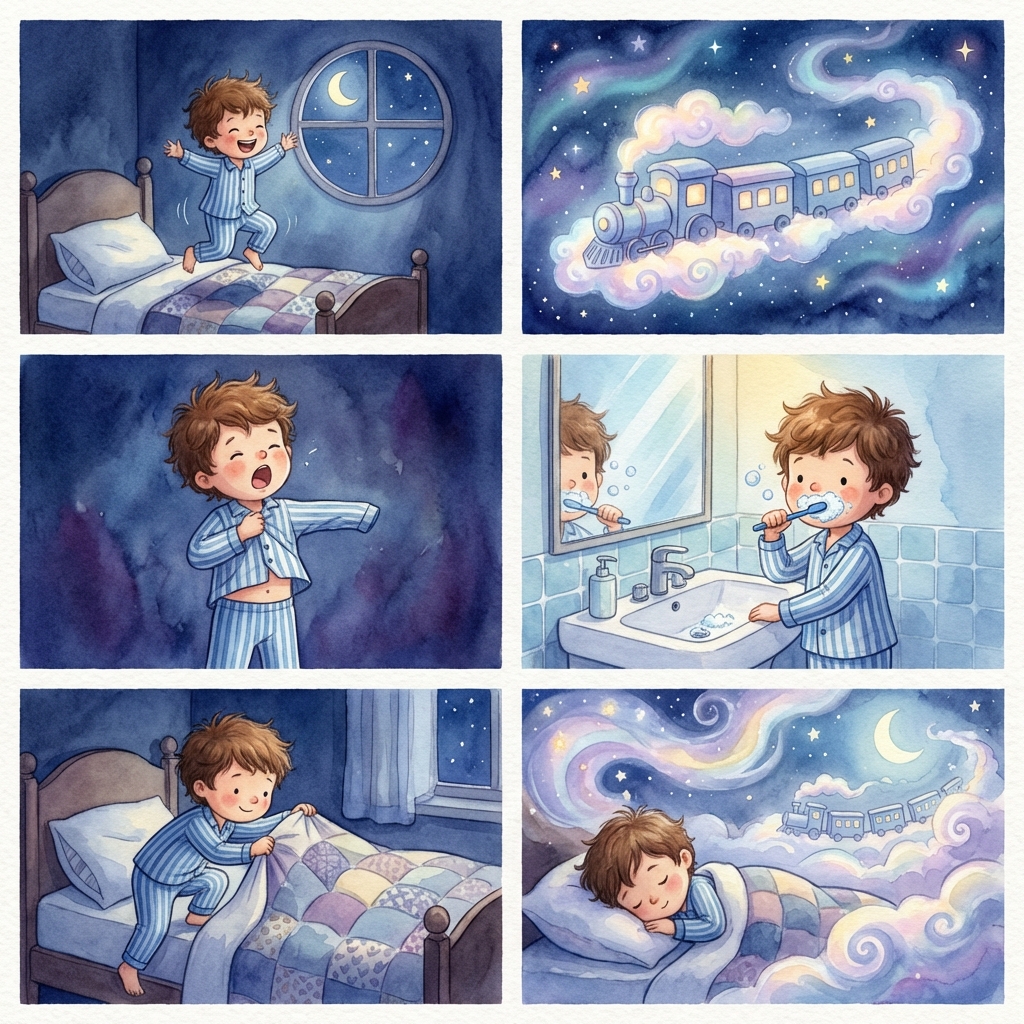
Psychologists studying how children process forthcoming events lean on what are called schema or script theories: children encode familiar experiences as scripts — first this, then this, then this — and use those scripts to predict, interpret and cope with what happens to them.5 A child with a script for "going to daycare" is running a prediction engine; a child without one is improvising under stress. A story about the event, told in advance, is script-installation: it gives the child the sequence, the sensory details, the feelings that might show up, and — crucially — how the story ends (someone comes back; the appointment finishes; home happens).
That's the theory. The evidence for it comes from four directions.
Evidence line 1: Social Stories
The most direct test of story-based preparation is the Social Story — the framework Carol Gray developed in the early 1990s, in which a short, personalised, first-person narrative describes an upcoming situation accurately and reassuringly. Thirty years of research, including a systematic review of controlled trials by Karkhaneh and colleagues, finds that well-constructed Social Stories can improve how children — the evidence base is strongest for autistic children — understand and manage social situations.1 We've covered that literature properly in our deep-dive on 30 years of Social Stories research, and the framework itself on our Social Stories explained page, so we won't re-litigate it here.
The point for this post is what the Social Story literature demonstrates about the mechanism: a narrative that is accurate, personalised, and introduced calmly ahead of time measurably changes a child's behaviour in the situation it describes. The story is doing the rehearsing on the child's behalf.
Evidence line 2: pretend play as rehearsal
Long before researchers built structured interventions, children built their own. Lev Vygotsky argued in his classic lecture on play that pretend play is where a preschooler operates ahead of their own development — "in play a child is always above his average age, above his daily behaviour" — trying on roles, rules and situations they cannot yet manage in real life.2 The toddler who spends the week before a doctor's visit giving their teddy injections is not being morbid; they are running the script at a safe distance, with themselves in the powerful role.
Honesty requires a caveat the play-advocacy world often skips. The most rigorous review of pretend play research, by Angeline Lillard and colleagues in Psychological Bulletin, concluded that the evidence does not support strong causal claims that pretend play is uniquely essential to development — for emotion regulation specifically, the research is "consistent with all positions but insufficient to draw conclusions".3 Pretend play is plausibly one of several routes to the same end, not a magic ingredient. What survives the scrutiny is the narrower claim that matters here: play is a natural, low-stakes medium in which children voluntarily rehearse the situations that preoccupy them — and a story gives that rehearsal its material.
Evidence line 3: watching someone cope
A third tradition asks what happens when a child watches someone like them get through the feared event. In a classic 1975 experiment, Melamed and Siegel showed children about to undergo surgery a film of a peer being admitted to hospital, feeling worried, and coping through each step. Compared with children shown an unrelated film, the modelling group showed significantly lower anxiety before and after surgery, and fewer behaviour problems once home.4
A personalised story pushes this one step further: the model isn't just like the child — it is the child, by name, walking through the day and coping. (Why self-referencing content holds attention so well is its own literature, covered in our post on the personalisation research.)
Evidence line 4: hospital preparation programs
Paediatric hospitals have spent decades systematising all of the above, because unprepared children do worse: more procedural distress, more post-discharge behaviour problems. The review by Jaaniste, Hayes and von Baeyer synthesised this literature and distilled when and how preparatory information helps: it should describe both the procedure and the sensations the child will experience, be pitched to the child's developmental level, and — for children over about four — arrive days rather than minutes in advance, giving time to process and ask questions.5 Preparation that arrives too late can be worse than none: the child gets the alarm without the rehearsal time.
Modern child life programs — including in Australian children's hospitals — operationalise this as photo walk-throughs, storybooks, and role-play with medical equipment before the day. It is narrative rehearsal with an evidence-driven delivery schedule.
Gentle exposure, in story form
Running underneath all four literatures is the oldest idea in anxiety treatment: graduated exposure. Anxiety shrinks when a person approaches the feared thing in tolerable doses, and stays regulated while doing so. A preschooler can't do formal exposure therapy — but a story is exposure at its gentlest possible dose. Day one, the story simply introduces the place. By day five, the child has met the educator's name, the bag hook, the goodbye ritual and the reunion, several times each, from the safety of a parent's lap. Each reading is a small, regulated approach toward the thing — with the parent's calm presence doing the co-regulating (a mechanism we unpack in our post on co-regulation).
This layered logic — script installation, coping model, spaced repetition, graduated approach — is the design brief for Little Narratives' 5-day preparation plans: one personalised story and song a day in the lead-up, so the rehearsal is spaced, gentle and finished before the big morning arrives. The same structure applies whether the event is the first day of daycare or a first dentist visit.
The honest limits
- No study has tested this exact stack. The evidence lines above are each solid in their own domain, but "a five-day personalised story-and-song plan" as a package has not itself been the subject of a randomised trial. We are applying converging evidence, not citing a trial of the product.
- Effects are modest and preparation is not prevention. Prepared children still cry at drop-off. The research consistently shows reduced distress and faster settling — not zero distress. If separation distress is severe or not easing over weeks, see our guide to normal versus concerning toddler anxiety.
- Accuracy is load-bearing. Script theory cuts both ways: a story that promises "it won't hurt" or "you won't be sad" installs a script the day will violate, and broken scripts cost trust. The preparation literature is emphatic that information must be honest about sensations and feelings.5
- Pretend play's causal status is genuinely unsettled. Lillard's review should temper anyone claiming play or stories are indispensable.3 Children have coped with big days for millennia without curated narratives. Rehearsal helps; it is not the only road.
Putting narrative rehearsal to work
The deeper reassurance in this research is that children are not fragile systems that big days damage. They are prediction machines that do badly with blanks and well with maps. Hand them the map early enough, in a form they can hold — a story, a song, a game — and they will do most of the rehearsing themselves.
References & further reading
- Karkhaneh, M., Clark, B., Ospina, M. B., Seida, J. C., Smith, V., & Hartling, L. (2010). Social Stories™ to improve social skills in children with autism spectrum disorder: A systematic review. Autism, 14(6), 641–662.
- Vygotsky, L. S. (1967). Play and its role in the mental development of the child. Soviet Psychology, 5(3), 6–18.
- Lillard, A. S., Lerner, M. D., Hopkins, E. J., Dore, R. A., Smith, E. D., & Palmquist, C. M. (2013). The impact of pretend play on children's development: A review of the evidence. Psychological Bulletin, 139(1), 1–34.
- Melamed, B. G., & Siegel, L. J. (1975). Reduction of anxiety in children facing hospitalization and surgery by use of filmed modeling. Journal of Consulting and Clinical Psychology, 43(4), 511–521.
- Jaaniste, T., Hayes, B., & von Baeyer, C. L. (2007). Providing children with information about forthcoming medical procedures: A review and synthesis. Clinical Psychology: Science and Practice, 14(2), 124–143.