Why children pay more attention to stories about themselves: the personalisation research
Say a child's name across a noisy room and their head turns — a reflex adults never lose either. Personalised stories borrow that reflex. The research says the borrowing genuinely works for attention and engagement, though it's worth being clear-eyed about what personalisation can and can't do.
Watch a three-year-old meet a story where the hero has their name, their curly hair and their dog, and you'll see something visceral: they sit forward. "That's me!" is one of the most reliable reactions in children's publishing, and it's the reason personalised books have gone from novelty gift to a serious research topic. The interesting question for parents isn't whether children enjoy stories about themselves — they obviously do — but whether that enjoyment translates into anything: attention, learning, comfort. The research says yes, with limits worth knowing.
The oldest attention hook there is
Psychologists have known since the 1950s "cocktail party effect" studies that your own name cuts through noise like almost nothing else — it's one of the few stimuli that can grab your attention even when you're attending to something else entirely. Personalisation in children's stories is, at bottom, an application of that reflex: it takes the most attention-worthy word in a child's world and makes it the doorway into the content you want them to take in.
A name is the first word that matters
How early does this hook exist? Remarkably early. In a classic study, Mandel, Jusczyk and Pisoni found that infants just 4.5 months old preferred listening to their own name over other names — even names with the identical stress pattern.1 A baby who can't yet sit up already treats the sound of their own name as special.
And the name isn't just recognised — it's used. Bortfeld and colleagues showed that 6-month-olds can exploit their own name as an anchor in fluent speech: babies learned and recognised a brand-new word when it followed their own name, but not when it followed an unfamiliar name.2 The child's name literally opens a slot in attention into which new words can land. That is about as direct a mechanism for "personalisation supports learning" as developmental science offers.
The self-reference effect: why "about me" sticks
The memory literature supplies the second mechanism. The self-reference effect is one of the most robust findings in memory research: information processed in relation to yourself is remembered better than information processed any other way. A meta-analysis by Symons and Johnson pooled 129 studies and confirmed that self-referent encoding reliably beats both general semantic encoding and thinking about the same material in relation to someone else.3 The standard explanation: the self is the most elaborate, most frequently used structure in memory, so anything hooked onto it inherits rich organisation and connections.
What happens when the book is about them
The direct evidence comes from Natalia Kucirkova's research program on personalised books. In an observational study with toddlers aged 12–33 months, Kucirkova, Messer and Whitelock filmed families sharing three books: a book personalised for the child, a matched non-personalised book, and the child's own favourite. With the personalised book, children and parents smiled and laughed significantly more than with the non-personalised one — and there was more vocal activity with the personalised book than with either of the others, including the long-loved favourite.4 More talk around a book is not a trivial outcome: as we cover in our review of the shared reading research, the conversation around the book is where much of the language benefit of reading lives.
Kucirkova's later theoretical work argues that personalisation's deeper value is agency — a personalised story positions the child inside the narrative rather than as a spectator, which can re-ignite interest in books for children who've gone cold on them — while also warning that personalisation done lazily can narrow a child's reading diet to an endless hall of mirrors.5 Both halves of that argument deserve to be taken seriously.
Why this matters for preparation stories
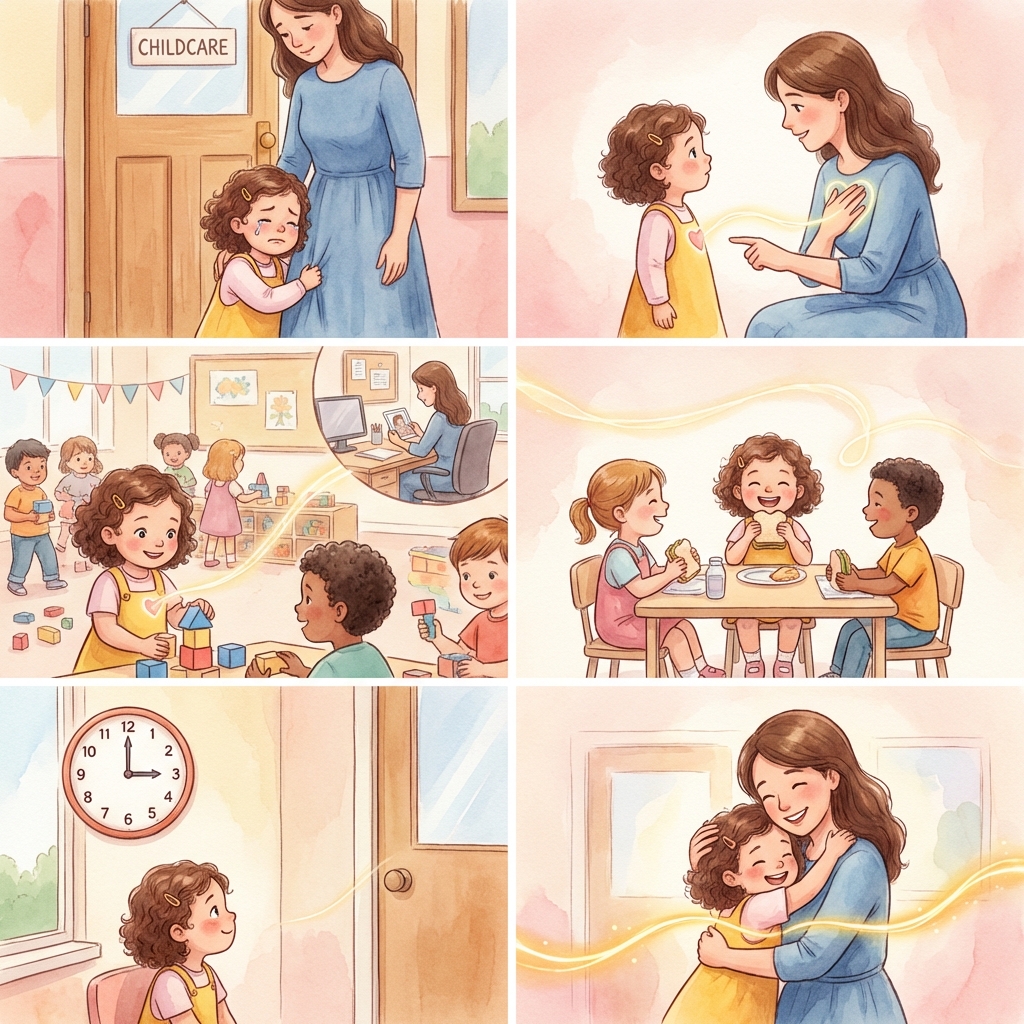
Attention and engagement are nice-to-haves in an entertainment book. In a preparation story — one that walks a child through an upcoming first day of daycare or dentist visit — they are the whole game. The story only helps if the child attends to it, encodes it and connects it to themselves; a child who hears "and then Ruby hangs her bag on the hook" doesn't need to perform the extra inferential step of mapping a stranger's experience onto their own. This is why personalisation is a core criterion of the Social Story framework (covered in our review of 30 years of Social Stories research), and why the rehearsal mechanisms we describe in our post on narrative rehearsal work best when the protagonist is the child. It's also the principle at the heart of Little Narratives' 5-day plans, where each day's watercolour story and song stars the child by name.
The honest limits
Personalisation is a genuine effect, not a miracle. Four honest caveats:
- The direct studies are small. The Kucirkova toddler study observed seven parent–child pairs.4 The findings are consistent with the larger attention and memory literatures, which is why researchers take them seriously — but the personalised-book evidence base is young and thin compared with, say, the shared-reading meta-analyses.
- Engagement is not the same as learning. More smiles and more talk are well-evidenced; direct vocabulary or comprehension advantages from personalisation are less consistently demonstrated, and some researchers caution that a child busy spotting themselves may attend less to the rest of the story.
- Personalisation can't rescue a bad story. A poorly structured, dishonest or frightening narrative with the child's name in it is still a poorly structured, dishonest or frightening narrative. The content standards — accuracy, warmth, a hero who copes — do the heavy lifting.
- A reading diet needs more than mirrors. Kucirkova's own caution: children also need stories about people who are not them — other lives, other places, other minds.5 Personalised stories are a tool for specific jobs (preparation, engagement, reluctant readers), not a replacement for the library.
Getting the most from personalised stories
The research, taken together, tells a modest and useful story. From 4.5 months, a child's name commands attention; through childhood and beyond, self-referenced material is encoded more richly; and when a book is about them, toddlers and parents demonstrably light up and talk more. None of that is magic. It's a reliable lever on attention — and for the big moments where a young child most needs to take a story in, it's a lever worth pulling.
References & further reading
- Mandel, D. R., Jusczyk, P. W., & Pisoni, D. B. (1995). Infants' recognition of the sound patterns of their own names. Psychological Science, 6(5), 314–317.
- Bortfeld, H., Morgan, J. L., Golinkoff, R. M., & Rathbun, K. (2005). Mommy and me: Familiar names help launch babies into speech-stream segmentation. Psychological Science, 16(4), 298–304.
- Symons, C. S., & Johnson, B. T. (1997). The self-reference effect in memory: A meta-analysis. Psychological Bulletin, 121(3), 371–394.
- Kucirkova, N., Messer, D., & Whitelock, D. (2013). Parents reading with their toddlers: The role of personalization in book engagement. Journal of Early Childhood Literacy, 13(4), 445–470.
- Kucirkova, N. (2016). Personalisation: A theoretical possibility to reinvigorate children's interest in storybook reading and facilitate greater book diversity. Contemporary Issues in Early Childhood, 17(3), 304–316.