Why knowing what comes next calms an anxious child: the science of predictability and routines
'Knowing what comes next' sounds like a small comfort. Neuroscience and half a century of family research suggest it's closer to the main event: uncertainty is the raw material anxiety is made from, and routines, schedules and rehearsal are how adults take that material away.
Ask a parent what calms their anxious child and you'll hear the same phrases again and again: "once she knows what's happening, she's fine"; "he just needs to know what comes next." The research says these parents have independently discovered something the anxiety literature regards as fundamental — and it explains why some of the most effective supports for young children are also the most ordinary.
Uncertainty is what anxiety runs on
In an influential review in Nature Reviews Neuroscience, Dan Grupe and Jack Nitschke put uncertainty at the centre of the science of anxiety: anxiety, on their account, is fundamentally an anticipatory state — excessive responding to possible future threat under conditions of uncertainty. Not knowing what's coming disrupts our ability to prepare, and the brain's threat circuitry treats that gap as a problem to be solved, loudly.1
Now consider a toddler's position. Almost everything is new; they can't read a calendar, a clock or a room; they have little control over where they go or when. A young child lives with a level of daily uncertainty that would rattle most adults. Seen through this lens, much toddler anxiety isn't a bug in the child — it's a rational response to genuinely poor information, and the fix is to improve the information. Every routine, schedule and preview an adult provides shrinks the space of "unknown things that might happen".
Fifty years of family routines research
The evidence that routine structure matters isn't new. Barbara Fiese and colleagues reviewed fifty years of research on naturally occurring family routines and rituals and found them consistently associated with parenting competence, child adjustment and family wellbeing — with routines acting as powerful organisers of family life that offer stability during times of stress and transition.2
A follow-up review by Mary Spagnola and Fiese focused on young children specifically: predictable routines provide "a predictable structure that guides behaviour and an emotional climate that supports early development", with variations in family routines linked to differences in socioemotional development, language and even later academic skills.3 The best-studied single routine is bedtime, where Mindell and Williamson's review ties a consistent nightly sequence to better sleep, better emotional regulation and stronger parent–child attachment.5 (Night-time is also where child anxiety and routines collide most visibly — see our article on night-time fears.)
It's also worth noting what routines do for the adult half of the equation. The OPRE co-regulation framework lists "structuring a predictable environment" as one of the three core things caregivers provide when helping a child regulate — alongside a warm relationship and skills coaching.6 A predictable day means fewer surprises for the child to process and fewer flashpoints for the parent to manage: the routine is doing co-regulation work before anyone has to say a word. (More on that in co-regulation before self-regulation.)
Visual schedules: predictability a non-reader can hold
Telling a three-year-old the plan helps; showing them works better. A visual schedule — a strip of pictures showing the steps of the morning, or the sequence of a new event — gives a pre-reader a version of the plan they can actually consult, and re-consult, without asking.
The strongest formal evidence comes from autism research: the National Professional Development Center's comprehensive review classifies visual supports, including visual schedules, as an evidence-based practice.4 Early childhood educators have long borrowed the tool for all children, and the logic travels well: whether or not a child is autistic, a picture sequence converts an invisible, adult-owned plan into something concrete and child-owned. In Australian early learning services you'll see them everywhere — wash hands, mat time, outside play — for exactly this reason.
Rehearsal: how a preview strips novelty of its power
Routines handle recurring days. But the moments that loom largest for young children — the first day of daycare, the dentist, a new sibling — are one-offs, and you can't routinise a thing that's never happened. What you can do is rehearse it.
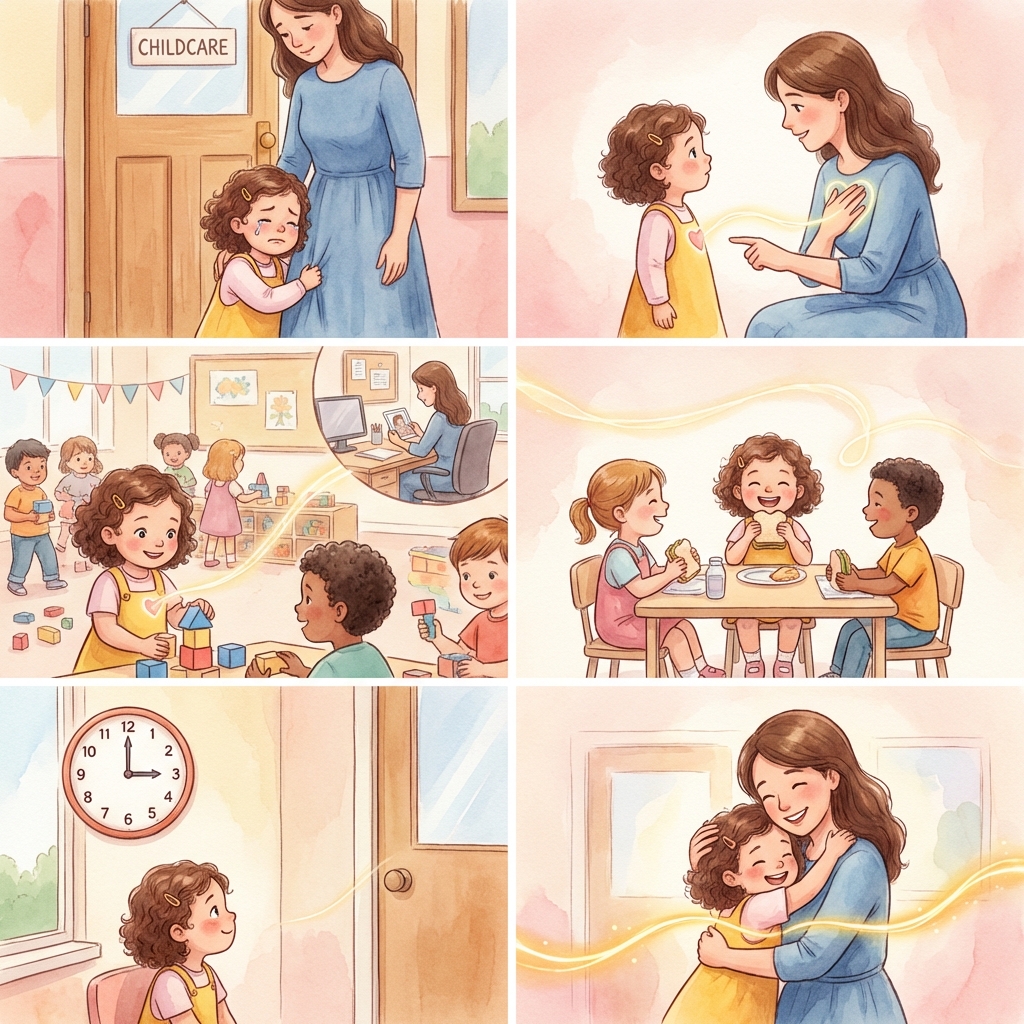
Previewing an event in words, pictures or story does two evidence-aligned things at once. It converts unknowns into knowns — directly attacking the uncertainty that anticipatory anxiety feeds on1 — and it lets the child meet the emotional content at low intensity, safely, next to a calm adult, before meeting it at full strength. This is the working mechanism of Social Stories and of preparation stories generally: the child who has walked through the story of drop-off five times has, in a real sense, already done five drop-offs. It's the research base Little Narratives leans on — a 5-day plan of personalised stories and songs is, underneath the watercolours, a predictability machine: the same child, the same upcoming moment, previewed gently until it stops being novel.
Building predictability without building rigidity
A fair worry: if predictability calms children, does a child who never meets surprise ever learn to cope with it? The research points to a balance rather than a fortress. Routines are the stable base from which children explore, not a substitute for exploration — Fiese's review found routines matter most during times of stress and transition, precisely when demand on a child's coping is highest.2 The goal isn't a life without novelty; it's novelty in doses a small nervous system can metabolise, with enough known-quantities around it. Weekend plans can change; the bedtime sequence probably shouldn't. And when a genuinely big change is coming, the answer isn't to protect the routine at all costs — it's to preview the change until it too becomes a known quantity. (Transitions between activities are their own daily battleground; see why transitions are so hard for toddlers.)
"Knowing what comes next" turns out to be one of the cheapest, best-evidenced gifts you can give an anxious child. It costs a routine, a picture strip and a story told in advance — and it quietly removes the one ingredient anxiety cannot do without.
References & further reading
- Grupe, D. W., & Nitschke, J. B. (2013). Uncertainty and anticipation in anxiety: an integrated neurobiological and psychological perspective. Nature Reviews Neuroscience, 14(7), 488–501.
- Fiese, B. H., Tomcho, T. J., Douglas, M., Josephs, K., Poltrock, S., & Baker, T. (2002). A review of 50 years of research on naturally occurring family routines and rituals: Cause for celebration? Journal of Family Psychology, 16(4), 381–390.
- Spagnola, M., & Fiese, B. H. (2007). Family routines and rituals: A context for development in the lives of young children. Infants & Young Children, 20(4), 284–299.
- Wong, C., Odom, S. L., Hume, K. A., Cox, A. W., Fettig, A., Kucharczyk, S., … Schultz, T. R. (2015). Evidence-Based Practices for Children, Youth, and Young Adults with Autism Spectrum Disorder: A Comprehensive Review. Journal of Autism and Developmental Disorders, 45, 1951–1966.
- Mindell, J. A., & Williamson, A. A. (2018). Benefits of a bedtime routine in young children: Sleep, development, and beyond. Sleep Medicine Reviews, 40, 93–108.
- Rosanbalm, K. D., & Murray, D. W. (2017). Caregiver Co-regulation Across Development: A Practice Brief. OPRE Brief #2017-80. Office of Planning, Research and Evaluation, Administration for Children and Families, US Department of Health and Human Services.